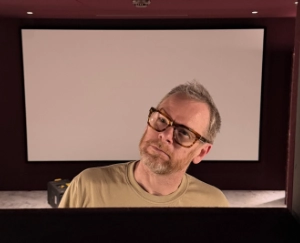
Home cinema design for architects & interior designers

Your clients deserve a cinema that actually performs
Most home cinemas installed in new builds and renovations don't convince. The most common reason is that the room wasn't designed with cinema in mind - wrong size, wrong proportions, ceiling too low, and space allocated too late in the process to fix any of it.
There aren't many of us working to this sort of level in the UK. If you haven't encountered one of us on a project before, that's not surprising - but it's worth knowing we exist.
What I do differently
Home cinema, done properly, is an engineering discipline.

I work to CEDIA's RP22 standard - the global recommended practice for immersive audio in cinema design - with defined performance targets for bass, dynamics, and spatial resolution. Typical installers don't work to or understand RP22; I helped write it.
The result is rooms that perform consistently at every seat, not just the one in the middle. Rooms that clients actually use, and talk about.
When to involve me
The ideal time is RIBA Stage 2 - Concept Design - before spatial decisions are fixed. For a serious cinema, the room dimensions, ceiling height, and what's above, below, and alongside all affect what's achievable. Getting this right at concept stage costs very little. Getting it wrong limits everything.

Stage 3 - Spatial Coordination - is the last good practical point. The room can still be right-sized, ceiling heights adjusted, and first-fix requirements can be properly specified.
By Stage 4 - Technical Design - we're working with whatever we've got. By Stage 5, we're on site and making the best of fixed decisions.
I'll always do my best job, but I can't bend physics to fit around a Gantt chart.
Right-sizing the room
This is where projects can go wrong - it's almost always a spatial coordination problem. A cinema room that's too large is as problematic as one that's too small.
Filling a large volume with controlled, even sound costs significantly more - and if the budget doesn't follow the room size, the result is a compromised experience - we're wasting the budget. A room that's right-sized for the brief, the real seating requirement, and the performance target will always outperform an oversized room on the same budget.
The right room size comes from understanding three things: the seating layout, the target performance level, and what the budget will support. I can give you that information quickly and precisely - but it needs to happen during space allocation.
The technical space
Every cinema has equipment that generates heat and noise: the rack, the amplifiers, the projector. Every building has services that do the same: MVHR, air conditioning, heating runs. Put any of that inside the viewing room and you're fighting it for the rest of the project's life.
A dedicated technical space - a rack room and projection cupboard - keeps it all out. The result is a room that's quieter, cooler, looks better, and is better. It also avoids a projector on the ceiling - that looks awful, makes the audience a little nervous, and adds fan noise exactly where we don't want it.
At Stage 2, this can all be factored in. By Stage 5 it's impossible. Identifying what's adjacent to the cinema room - plant, utility spaces, circulation - and routing services accordingly is a five-minute conversation at concept design. It will make a profound difference to what the room achieves.





Surface matters
Surface properties make an enormous difference in a cinema room - far more than most people realise.
The goal is 'Goldilocks' acoustics: controlled so that the soundtrack has clarity and weight, lively enough that conversation feels natural. Too far either way and something feels wrong, even if nobody can name it.
Light reflectivity is also critical - shiny, glass, or metal surfaces need to be kept well away from the screen area, or it causes unwanted distractions.
Performance and style
Performance design is my responsibility - acoustics, geometry, sightlines, bass. That's non-negotiable, because if it's wrong the room doesn't work, regardless of how it looks.
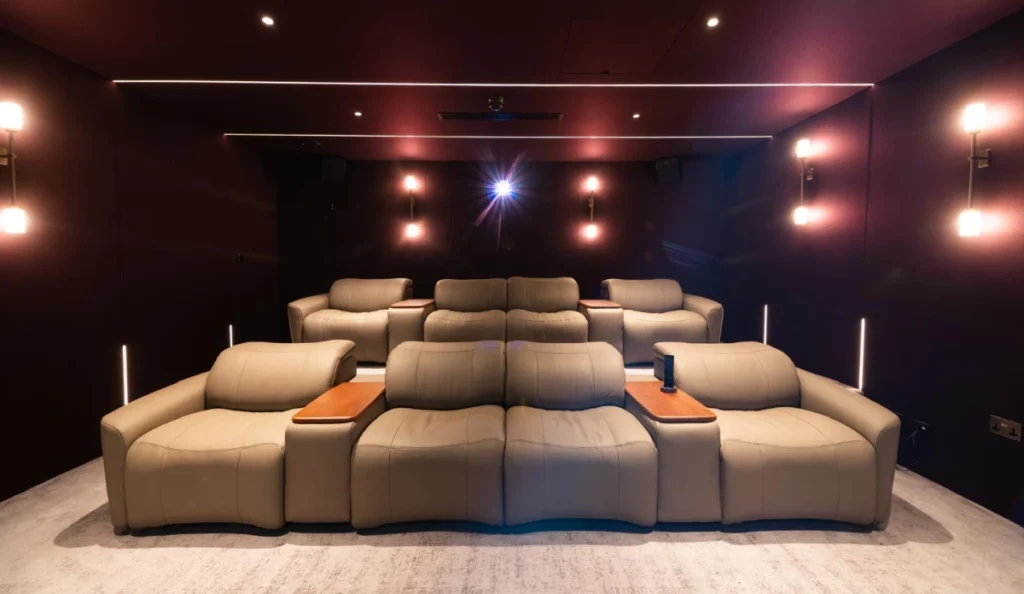
Basement cinema, London, from drawings above.
Collaboration: Lomax & Chi (interior design), Louise Tarling Ltd (installation)
Style design is a different conversation. Colours, textures, finishes - I'll take direction from the whole project team, and I want to. The best rooms come from real collaboration between me, the architect, the client, and the interior designer. But there are constraints, for a reason. Style serves performance, not the other way round.
How I work
A home cinema designer who communicates clearly, works to your programme, and documents thoroughly, to CEDIA award standard.
I hold all three higher-level CEDIA certifications - the only installer in the Southwest to do so. I was lead author on the RIBA and BIID-accredited CPD course for architects and interior designers, and I sit on the global working group that develops RP22 and future standards.
That's the context in which I work, and it shows in the documentation.
What I won't do
Most installers are too nervous about losing the sale to say what needs saying.
Their results are often poor: beige projection rooms with a washed-out picture, viewing rooms that are over-absorbed and feel unnervingly dead, or rooms so full of glass and marble they echo like a bathroom - then you can’t hear the words clearly, especially when it’s Tom Hardy.
I push for the best answers early - the technical space, the right materials, the right proportions - that produces work I'm proud of, and happy clients.
You'll recognise the dynamic I’m sure: the advisor who lobbies for the best outcome, even when it's a harder conversation, tends to get the best results.
Let's go to the cinema
The best way to understand what a properly designed cinema room can do is to see, hear, and feel it.
I run the RIBA and BIID-accredited CPD course from my Bristol cinema - which means you'll spend time in a room built to demonstrate exactly what this standard of work achieves.
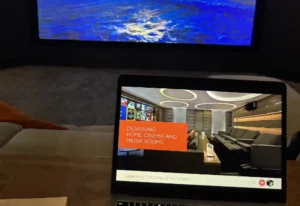
Most attendees leave with a completely different sense of what's possible.

If you have a project at any stage, get in touch. The earlier the better.

WRITTEN BY
Owen Maddock
Owner & designer, Cinemaworks
I've spent twenty years looking for ways to make films feel more real in people's homes.
CEDIA® Member of Excellence, award-winning designer, podcast host, and the one you'll actually work with.