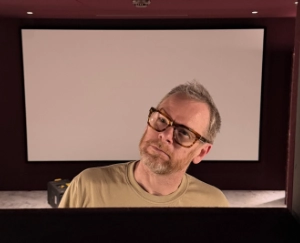
Our Bristol showroom
Performance and style - design detail
Read this. Then come and feel it.
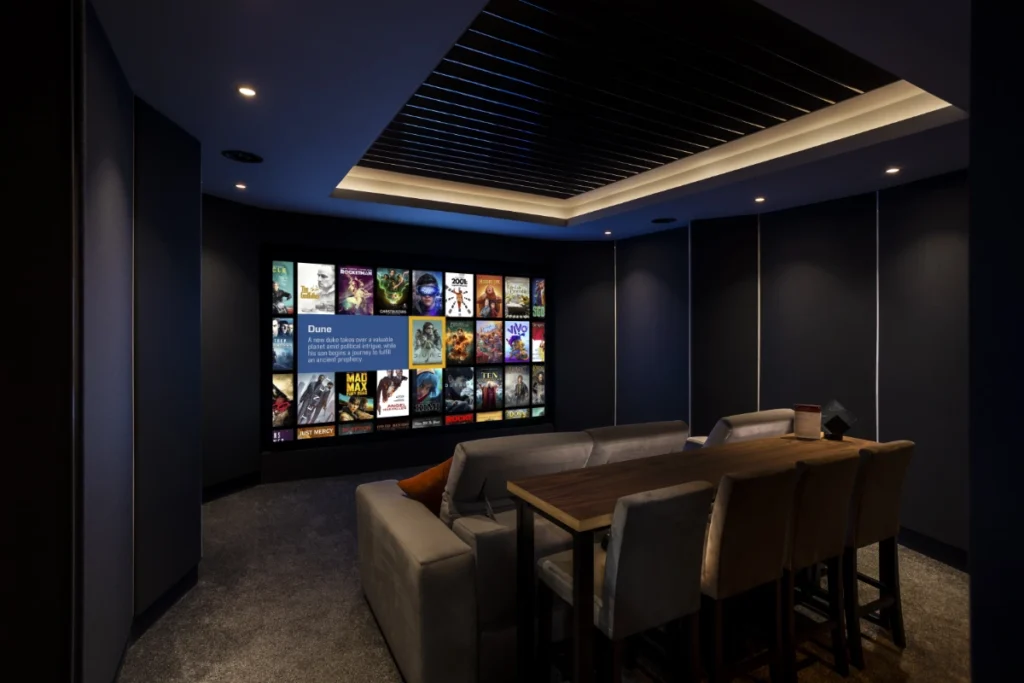
The showroom is in Redland, Bristol - inside Fraser Besant Lighting at 33 Zetland Road. It's a working demonstration space, not a shop. You come in, sit down, and see, hear and feel what a well-designed cinema room is actually like. Most people haven't experienced one before.
I set out to be the best-performing home cinema demonstration below £100k in the UK, and the best in the South West full stop. It's a bold claim, but I'm comfortable with it. Our room was also a CEDIA Smart Home Awards finalist in 2023, for Best Showroom.
The system uses 13 channels of Klipsch THX speakers in 9.2.4 Dolby Atmos configuration, with Anthem amplifiers, 3m width screen, and JVC NZ800 laser projector. Everything in it was chosen and placed deliberately - the design choices behind it are worth explaining, because they're the same ones we bring to every project.
Speaker choice
Most home cinema speakers sold in the UK are hi-fi speakers - designed around music, and not quite right for cinema. The difference matters more than most people realise.
Film soundtracks are more dynamic than music - quiet whispers to full-scale explosions, sometimes split-seconds apart. Hi-fi speakers often become harsh and strained when pushed. If your system doesn't reach high levels cleanly when things get loud, you'll turn it down, and then struggle to hear the words when it gets quieter.
The only reason many installers use hi-fi speakers for cinema is force of habit and relationships. There isn't a sound technical argument for it.
For our room I used Klipsch THX speakers. THX was founded by George Lucas and Tomlinson Holman in 1983 - born out of frustration at poor sound quality. It evolved into a rigorous certification programme covering dynamics, off-axis response, and frequency accuracy. Every THX certified speaker has been tested to perform at reference level without distortion, with a smooth response for listeners off to the sides, and a tonal balance that matches what the director signed off on in the studio.
The THX performance classes - Compact, Select, Ultra, Dominus - aren't quality levels. They're about room size and viewing distance. The showroom system is Select-class at 4.5 x 5m; a larger room would need Ultra or Dominus to achieve the same result. Getting this right is one of the things I check on every project.
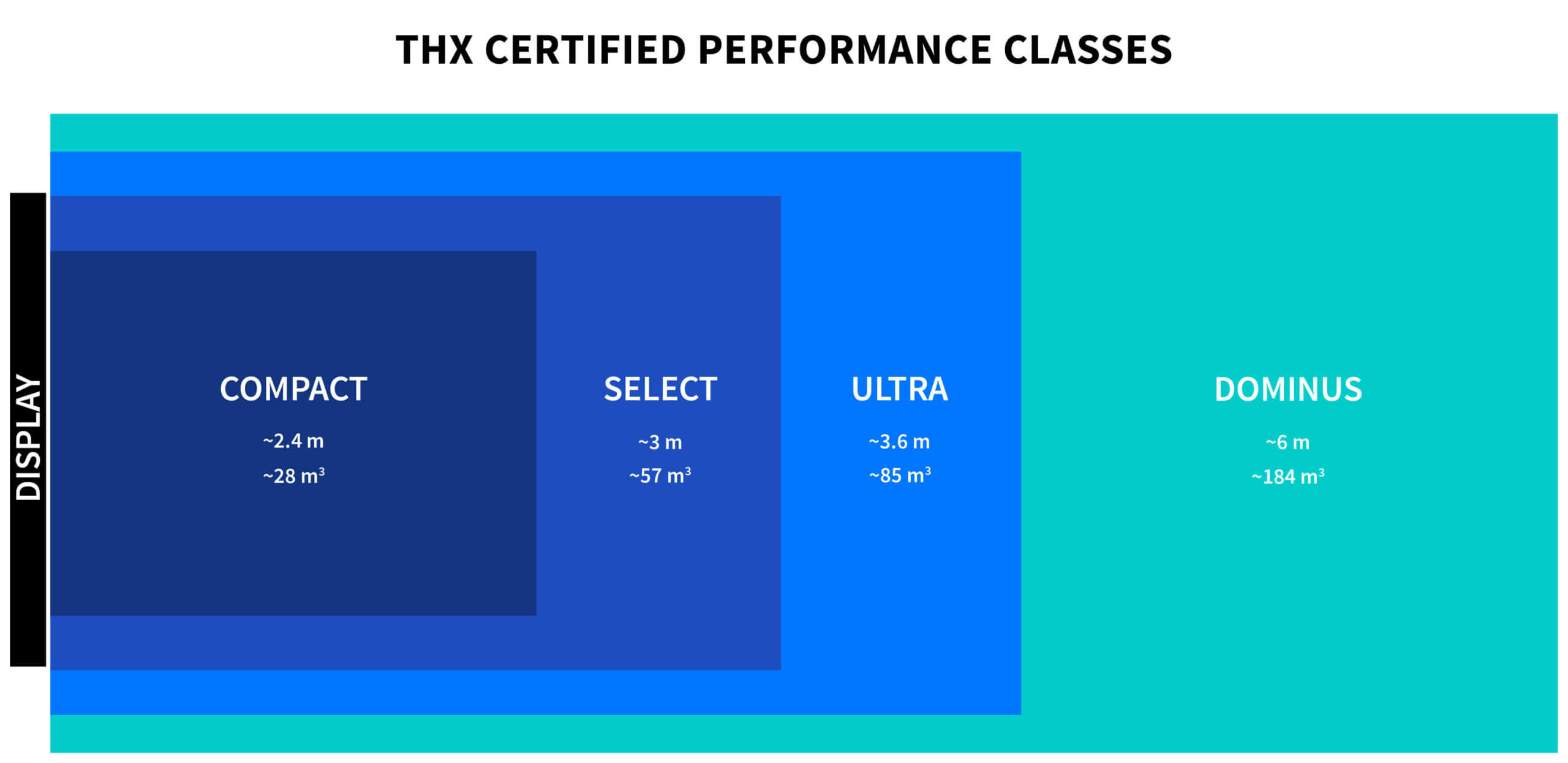
Thanks THX Ltd for this explainer image.
Speaker placement
Placement is where a lot of systems quietly fail - not through bad equipment, but with insufficient care about where everything goes.
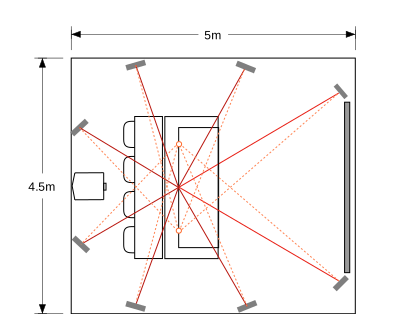
The standard approach is to optimise speaker positions from a single point halfway between two rows. The problem is that nobody sits there, and one row almost always ends up outside the relevant guidelines as a result - typically the back row, where the front left and right speakers are too narrow. That means the back row hears a different soundstage to the one the director intended, and to what the front row hears.

I placed our front left and right at 30 degrees from the front row - as recommended by the ITU (International Telecommunication Union), which sets the standards all serious mixing studios are built to. At 30 degrees, both rows sit within Dolby's guidelines, and the front row meets the ITU standard. Everyone gets a result closer to what the soundtrack was designed to sound like.
Common, but flawed:

Back row outside guideline 22.5-30º
Better:

Both rows within Dolby guidelines;
front row meets ITU guide of 30º
The same principle applies to surrounds. A common error is placing surround speakers in front of some listeners, or with surround-back speakers on the wrong side of some seats. Sound coming from the wrong direction isn't pedantic - it's directly against creator intent and spoils the illusion. With care in the design stage, it's avoidable.
I also added front-wide speakers to fill the gap between the front and surround channels. Without them, a sound event moving around the side wall passes through a hole in the soundfield. With them, the transition is smooth and the sense of envelopment is noticeably better.
Cross-firing and zig-zag
Getting the placement right goes a long way. The next step is cross-firing - a technique I first encountered on training with Trinnov, and saw used in some very high-end systems while judging the CEDIA awards.
Every speaker has a listening window - within roughly 20 degrees either side of the centre - where it sounds its best. Outside that window, response becomes more uneven and the level drops. Cross-firing uses toe-in to even up the response at each seat.
It goes like this: the listener in the left seat is closer to the left speaker than the listener in the right seat is. Pointing the left speaker directly at the right listener helps compensate for that - it takes the level up slightly for the person furthest away, and down slightly for the person closest.
Repeat for all speakers and the result is a more even performance for everyone - I optimised ours for the front three.
This means the speakers can't sit flat against the walls - they need to point towards the correct listener. Instead of hiding it behind a flat fabric wall - which I sometimes do, we built the walls around the speakers instead. The angles became a feature, created for deep acoustic treatment nearest the screen, and it looks really cool.
Style and lighting
I work closely with Fraser Besant Lighting, my hosts at Zetland Road. As well as supplying all the Rako scene control we use in most of our projects, the showroom runs 35 metres of high-density RGB pixel tape driven by Madrix - lighting programmer Max also looks after major bands, clubs and corporates.
The results are spectacular.
Party time
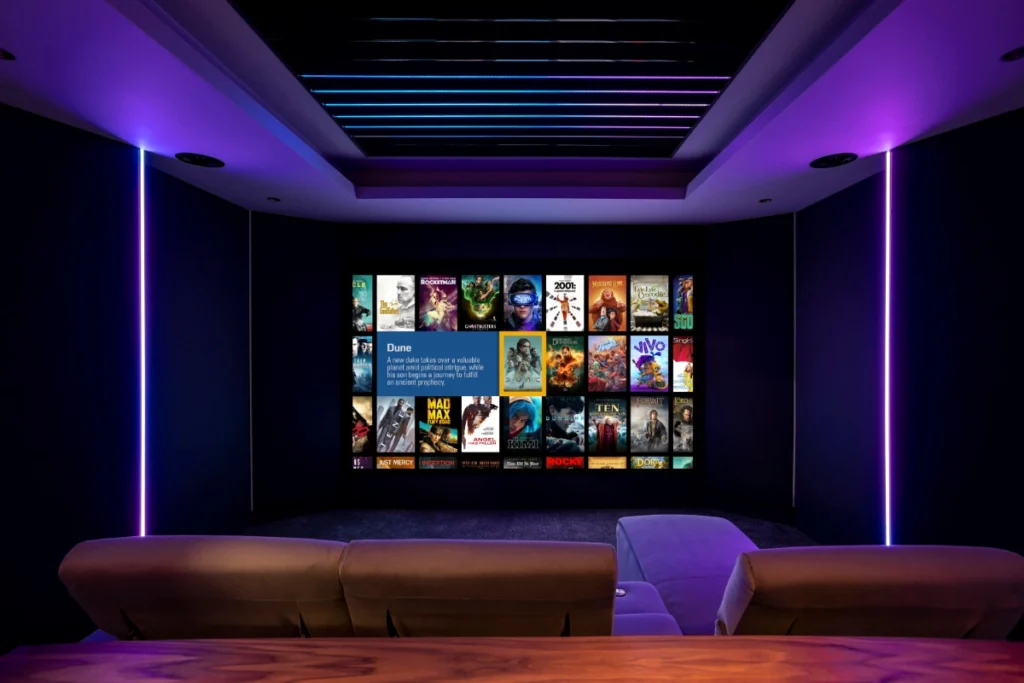
And relax
Same cinema, different lighting - it makes a huge difference to the feel of the room
One scene turns the walls into a live graphic equaliser - the LED strips pulse in time with what's playing. Others are set up for sports, parties, or just for fun. The possibilities are, within reason, endless. I really love the pixel effects when I'm listening to music, particularly electronica - hi-fi can struggle with cinema dynamics, but a great cinema system plays music extremely well.

A room like this isn't just for watching films in. Come in and see what we can do.
See, hear and feel it
Reading about a well-designed room is one thing; how it makes you feel is another.
The showroom is open by appointment. Call 0117 214 0115 or email design@cinemaworks.co.uk to arrange a visit, or fill in our new project form to give us some background.

WRITTEN BY
Owen Maddock
Owner & designer, Cinemaworks
I've spent twenty years looking for ways to make films feel more real in people's homes.
CEDIA® Member of Excellence, award-winning designer, podcast host, and the one you'll actually work with.