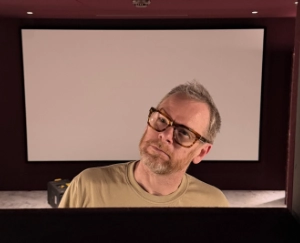
Grounded in psychoacoustic research
The three founders met while working at IRCAM in Paris - a research institute dedicated to electronic sound creation, and part of the Pompidou centre.
Their research led directly to the creation of Trinnov Audio ('tridimensional innovation'), which operates in three main markets: commercial cinema, content creation studios, and high-performance residential.
So, rather than an established audio brand looking for the best solution they could find, Arnaud and colleagues worked out what matters most to create a convincing three-dimensional sound field, for multiple listeners, then set about designing it.
A very different starting point.

Trinnov has also raised the bar in cinema room design.
The placement guidelines have helped designers create a larger sweet spot, for more listeners, in more seats, and were a direct influence on CEDIA/CTA RP22.
Altitude - Powerful, flexible, upgradable
The Altitude 32 surround processor was first released in 2014. With entirely software-based processing, it remains completely current and highly relevant.
Altitude 16 followed in 2017, and the latest Altitude CI is now available - a very flexible new processor with up to 32 channels, bringing Trinnov quality and power to an exciting new price point.
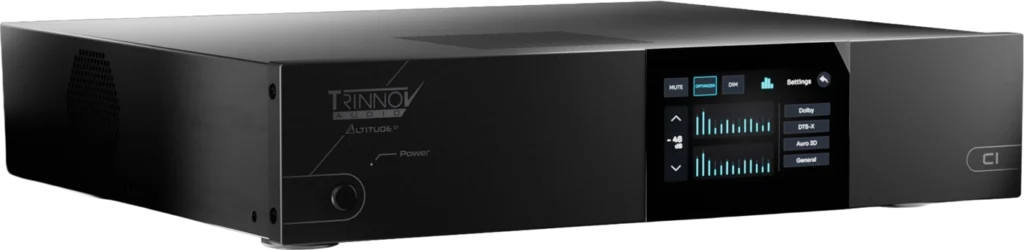
NEW Altitude CI surround processor/decoder - cost-effective and scalable
The major advantage of the Altitude platform is processing power - all Altitudes have at least 10x the power of off-the-shelf DSPs used by other brands. This gives far greater scope for precision audio corrections, greater resolution, and higher timing accuracy.
The platform is also remarkably upgradable. HDMI cards have been updated as the format has evolved. Channel counts have increased - Altitude 32 now supports 36 channels, or up to 64 with the expansion unit; Altitude 16 now has 20.
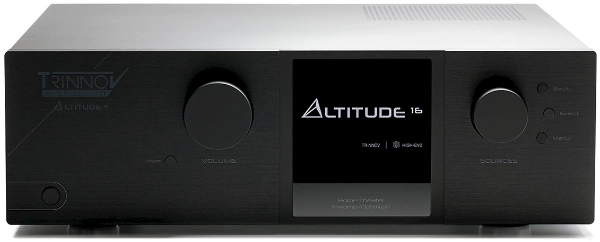
Altitude 16 - now with 20 channels
All improvements and innovations - notably WaveForming bass control, released in 2024 - are provided free of charge to all Altitude owners.
I only know of one AV processor that is still current and can be upgraded to the very latest decoding spec, twelve years after release.
It's about time
Trinnov time-aligns speakers to 0.01ms accuracy (around 3mm in distance), where most work to 0.1ms. This makes a huge difference - it's harder to get exactly right, and very much worth it when you do. Crossovers and EQ are similarly time-accurate, and all channels are processed at the full 192kHz, where others have to downsample and lose accuracy.
When everything arrives exactly in time, it feels like you've removed the glass in front of a painting.
All that remains is the art.
Speaker remapping
Even in a high-level system, bringing real cinema into the home has its challenges - you can't always place every speaker exactly where it should go. Usually, that's a performance compromise we have to live with.
One use of the extra processing power all Altitudes carry is speaker re-mapping - a patented technology that 're-maps' sound from where the speaker actually is, to where it should be. Re-mapping also lets us optimise for every decoding format; there are small differences in ideal placement for Dolby Atmos, DTS:X/Pro and Auro-3D, and this lets us overcome them.

Advanced measurement and calibration tools
A Trinnov processor is a high-precision instrument, and it gives a calibrator advanced tools to match.
Trinnov uses their own 3D microphone - four capsules in a single unit, each receiving sound at slightly different times. Together they allow the processor to build a detailed internal model of exactly where sounds are coming from and how they interact with the room - foundational to the Optimizer room correction system.
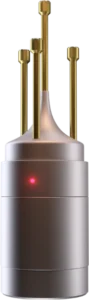
3D mic - four high-quality calibration microphones in one unit
For really great results, we let Optimizer do what it's genuinely great at, particularly in the time domain, then manually tune the system according to experience, judgement, and the customer's preferences. We get everything we need to understand how a speaker sounds in that room, and can tailor accordingly, whether that means digital corrections or adjusting the acoustic response of the room itself.
Calibrating a Trinnov setup is not for the faint-hearted - you need experience and training.
WaveForming - better bass, everywhere
WaveForming is Trinnov's most recent innovation - unique, patented, launched in 2024, and steadily improving.
Getting great bass for everyone in smaller rooms is a difficult problem - even a very large home cinema is considered a smaller room acoustically. Bass notes bounce off the walls, causing hot spots and dead spots. Until recently, we could only partially overcome this, by using multiple subwoofers and placing seats where the bass is most even.
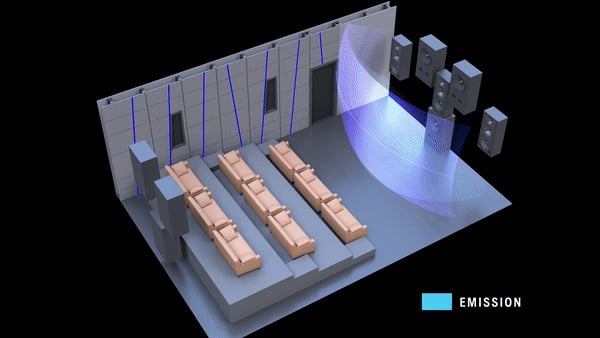
Waveforming - planar bass wave from the screen wall
WaveForming uses multiple subs in the front and back walls - the back subs 'collect' the bass wave before it can bounce back into the room and cause problems.
The emotional bit
How does it make you feel?When I get chatting about my job, people often say they ‘wouldn't hear the difference’. Everyone who's been through so far says otherwise, regardless of experience or technical knowledge.
We don’t do this for the technology, or for geek points. Technology, calibration, the quest for performance, that’s just how we get there. It’s the means to an end.
The goal, the point, the why is: to make you feel it more deeply.
My showroom ran on Anthem for four years - it’s a proper, solid make. The changes over that time were in calibration: I got better, with help from my friend Tom Delli, and went back to it periodically.
This step up to Altitude 32 and two Primare A35.8s is a massive step forwards. It’s probably the biggest transformation of a room I’ve ever made.
I wasn't completely expecting it.
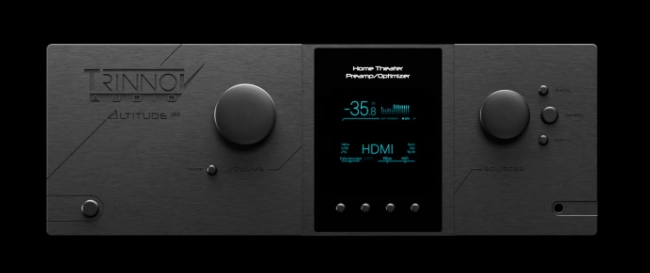
Altitude 32 - the OG high channel processor
Now showing at Cinemaworks
I knew the calibration tools were more precise and powerful. I knew the time alignment was many times more accurate - from around 5cm to a few mm.
What I didn't anticipate was my own emotional reaction to it, after a few days of solid work in EQ, Optimizer and timing adjustments - using Trinnov’s 3D mic and my own calibration rig.
David from Trinnov puts it very well - it’s a bubble of sound. There’s no gap between speakers. The word ‘immersive’ is over-used nowadays, but this is what it really means; you’re bathed in it.
The envelopment, that thing that makes you stop thinking about the room you’re in and just be in the film, is much stronger. On top of the best processing in the world, and the tightest timing, the new power amps have given me a bigger engine.
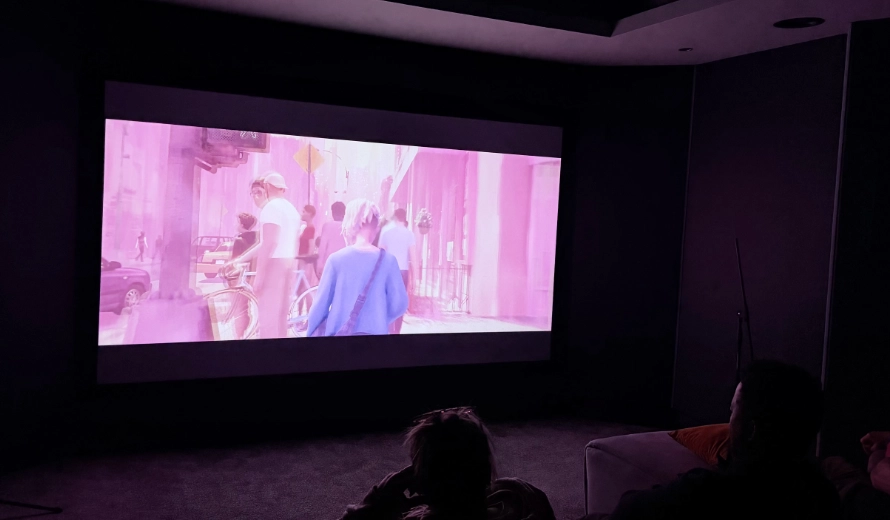
Testing Cinemaworks 2.0 with friends from CEDIA
It’s most obvious at high volumes, when things are busy in the soundtrack. There's more separation between strands, more clarity, more solidity to each event. At loud peaks and fast transients, I suspect the previous setup was compressing a little, power supplies weren’t quite keeping up. It wasn't bad at all, it was very good and I was justifiably proud. But now it’s stepped up again, I can’t unhear it. In fact, I’m struggling to stay out of there.
And it’s not just the loud bits. Microdynamics - subtle variations in intensity - come through much more clearly. In one of my go-to music tests, Hannah from London Grammar varies the intensity of 'now' as she holds the note; you feel it in a way you just didn't before.
All I’ve changed are the electronics. All the speakers and acoustic materials are the same, and yet it’s a completely different room.
It goes deeper than I expected. Come and feel it.

Trinnov home cinema FAQ
▸Which Trinnov processor is right for me? Altitude 32, 16, or CI? Does the CI replace the other models?
Let's look at them in turn:
Altitude CI
is flexible, scalable and affordable - the base channel count is 8, expandable to 32 with software licenses - you can purchase the channel count you need now, and add more later - say when adding more speakers or upgrading your subs to WaveForming.
However, the CI has maximum 8 analogue outputs - any further channels must be over Dante / AES67 or AES/EBU digital. This explains some of the cost saving - the unit is physically smaller, and has fewer top-notch digital to analogue converters. Dante / AES67 is really growing in popularity - it keeps the signal in digital form for longer, massively simplifies rack wiring, and is highly flexible - many excellent power amplifiers are now Dante-enabled, including Trinnov's own.
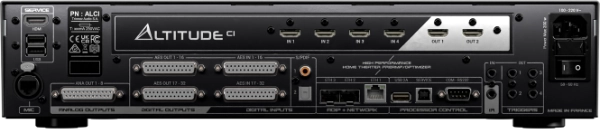
Altitude CI - back panel
If you already own very good power amplifiers with analogue inputs, say if you're upgrading an existing cinema room, you'd be better off with Altitude 16 or 32.
The other thing of note is that Altitude CI has four HDMI inputs - that's enough for many, but you might want more. In practice, a high performance room is pretty likely to have video processing, and those units often have very good video switching. Alternatively, high quality HDMI switching units can be found quite affordably. 'Secondary' sources can go on the HDMI switch, leaving three direct inputs for high priority equipment - disc player, streamer, and a Kaleidescape player.
Altitude 16
The practical benefits over the CI are: 16 analogue outputs (with four extra channels via SPDIF digital) and 8 HDMI inputs - you'll know if you need them, or I can help you decide.
Altitude 32
At the time of writing, the CI is limited to 32-channel decoding - Altitude 32 can support 36, or even more using the Altitude 48 EXT (48 decoded channels / 64 processed).
There are good reasons you might want to do this - larger rooms with rows of seats, a large number of Waveforming subwoofers, or if you want to run the ideal layout for every audio format - perfection, but you have to spend more.
For very high channel cinemas, the OG Trinnov processor is still the best, perhaps the only choice.
▸What about Trinnov power amplifiers?

▸Isn't a Trinnov just a PC in a fancy box?

▸Do I need a specialist to install and calibrate a Trinnov system?

▸What's the best alternative to Trinnov?
I have a lot of love for Storm Audio. They go about things differently, and rather well - the products have excellent flexibility, a well-defined upgrade path, and are highly suitable for expert calibration.
Crucially - and similarly to Trinnov - the units all have much greater DSP power, so if you compare against other DIRAC-enabled products, the Storm can run many more high-precision correction filters, ensuring a smoother, better-sounding result in the room. Storm also lets us apply pre-EQ corrections before we run the DIRAC process, for a better result all round.

Storm Audio ISP Elite mk3
The 'best answer' for a given room and a particular client will depend on absolutely everything - and we'll almost always find a budget limit.
Really great Level 1 cinemas can be made with an AV receiver with built-in amplifiers; as things move up in performance, you'll most likely want a dedicated processor. If I'm helping you with that, it'll probably come from France.

WRITTEN BY
Owen Maddock
Owner & designer, Cinemaworks
I've spent twenty years looking for ways to make films feel more real in people's homes.
CEDIA® Member of Excellence, award-winning designer, podcast host, and the one you'll actually work with.