Designing better bass for home cinema

'Bass - how low can you go'

© Public Enemy - I'm a massive fan
Why is this important?
Two things about bass in a home system really matter:
First, bass plays a crucial role in how music and film make you feel. Get it right, so it's proportionate, even, and deep, and the emotional impact is significantly more powerful.
Second, achieving great bass in domestic rooms is a hard engineering problem. Much more so than in cars, concert halls, or commercial cinemas.
In our home-sized rooms, certain bass frequencies bounce around the walls, floor and ceiling, creating areas of cancellation and reinforcement in different places. That's not what you want - too much or too little sounds off, and feels wrong.
Overcoming these 'room modes' needs real design work.
Advanced research and settled science
Dr Floyd Toole and Todd Welti spent decades researching this - the biggest takeaway is that humans always prefer a smooth, even response when listening, without any 'lumps and bumps'. The problem of room modes is serious, and worth fixing.
The book Sound Reproduction is a reference text for serious home audio designers, and Todd's section on bass is highly comprehensive.

'Sound Reproduction' 4th edition - the bible for a serious cinema designer
'Physics hasn't changed since I wrote my book'
In summary: multiple identical subwoofers, placed correctly, give us the most even results across the seating area. The ideal positions change with room dimensions - what works in one room, almost certainly won't in the next.
Get on the mics
Software predicts the room modes accurately, but assumes a perfect room - like a concrete box without a door. Real rooms aren't like that. So we must take real measurements, as early as possible.
At a recent, fairly modest Somerset project, I installed two subs, but cabled to four locations.
That paid off - the best combination wasn't what the software predicted, and worked very well. I didn't need as much digital correction later, as it was improving on a good result, not trying to fix a bad one.
The ideal workflow is: software can rule out the worst locations, then microphones help us find the best.

Measurement microphones and audio interface
The measuring process took me a morning. Well worth doing, but most installers don't.
Seat count and room layout
This matters more than you might imagine. You can't get good bass in a seat that's too close to a side or back wall.
I often suggest we should reduce the seat count, so they can all sound really good. Even 150mm of seat movement can take a listener out of a cancellation or pressure zone.
Power, output, and depth
Most subwoofers and amplifiers sold for home cinema don't have enough output for the rooms they're used in. That overblown, distorted bass - I'm sure you've heard it - is the sound of amplifiers running out of power and then clipping.
Everyone hates distorted bass - you'll either turn it down, or switch it off. The illusion is ruined.
Often, systems just don't go low enough. Film soundtracks regularly contain content well below 20Hz, sometimes as low as 6Hz. Many home cinema subwoofers can't get below 30Hz - and even CDs do.
Badly specified and implemented systems don't do much below 40Hz - not because physics won't allow, but because the design work wasn't done.
Only a few manufacturers publish the data we need to design bass correctly. Without it, we're guessing - and that doesn't go well. It often means that bass goes loud or low, but not both - and the very lowest frequencies, which have the strongest impact on your feelings, are either inaudible, or distorted.

In a recent London project, we used four 12" AIA passive subwoofers with a 4800w Powersoft amplifier - 1200w per sub, for a room just over 6m long, targeting RP22 Level 2.
We did this to ensure clean power and output at the very low end. It goes seriously loud, and response is even down to 18Hz - and we could only do it because Ascendo Immersive Audio publish all the data we need.
These numbers may seem like overkill. They aren't, if you want to really feel the impact and bass that's already in the soundtrack.
An upcoming super cinema project uses 20kW for the subs - 10kW across four main 'kick' subs, and a further 10kW for the infra.
Infra-bass: can you feel it
Most home cinema subwoofers are specified down to 20Hz. That's the theoretical lower limit of human hearing, and the lower limit of a CD. Film soundtracks don't stop there, and quite a lot of modern music doesn't either.
Some of the most effective moments in cinema go much lower. Black Hawk Down, Dune, Blade Runner 2049 - sections of these soundtracks can reach as low as 6Hz. You won't hear infra bass, but you can feel it. There's a physical sensation of excitement, tension, even dread - the soundtrack is literally moving you.

Ascendo Immersive Audio 32" infrasonic
AIA pioneered the infra-bass category
Even modest extension into the infra-bass region makes a big difference. Getting down to 18, 17, or 16Hz noticeably improves the impact. You don't need to reach single figures to feel the benefit, though with higher budgets, we can.
Something interesting happens to the rest of the bass when you add infra capability - the bass you can hear sounds and feels tighter and more solid.
I believe two things are at play - main subwoofers are relieved of the hardest work, so they perform better in their own natural range; and the infra content underpins audible bass notes in a way that makes them feel more grounded and real.
Doing this well isn't cheap - infra-bass requires significant driver area, cabinet volume, and amplifier power. But it's one of those upgrades you'll feel immediately, even if you couldn't explain why.
Active acoustics - correcting the room in real time
Traditional acoustic treatment is 'passive' - absorption panels, diffusers, bass traps. It's important, but treating the very low end needs a lot of space; usually more than we've got.
Active acoustics uses multiple speakers and processing to correct what the room is doing in real time.
Two active bass systems are currently available:
Trinnov WaveForming
This is a Trinnov technology, using dedicated subwoofers at the front and back of the room to physically absorb the bass wave, before it can reflect and cause room modes.

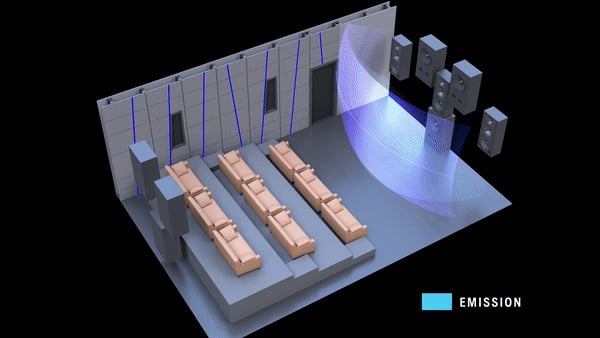

WaveForming needs an Altitude processor, extra subwoofers, and very careful placement, and the results are genuinely state of the art - exceeding CEDIA's RP22 Level 4 metric for consistency across seats.
Dirac Live ART
Dirac Live Active Room Treatment takes a different path.
It uses every speaker in your system, to generate cancellation signals which suppress room resonances and reduce bass decay time. The result is tighter, more even bass and a cleaner overall sound.
It doesn't use extra subwoofers or changes to the system. ART works up to 150Hz, so you can be significantly less reliant on passive treatment in that range. With multiple subs, results are significantly improved compared to a non-active system.
Now available on products from Storm Audio, AudioControl, Marantz and others, it's more accessible than WaveForming.


Dirac Live ART brings meaningful bass and acoustic improvements for speakers you already own, where WaveForming isn't feasible, or budget won't stretch to Trinnov.
Taking this to a deeper level
If you'd like me to design the bass, and the rest of your home cinema, let's talk.

WRITTEN BY
Owen Maddock
Owner & designer, Cinemaworks
I've spent twenty years looking for ways to make films feel more real in people's homes.
CEDIA® Member of Excellence, award-winning designer, podcast host, and the one you'll actually work with.